Searches for crypto dice mostly land on pages selling a system. This one does not: what follows is the arithmetic of the game, and the line between what the game decides and what an operator decides.
Probability and payout are the same slider
Move the threshold and you move both at once: a bet that wins 90% of the time pays barely more than the stake, one that wins 2% of the time pays a large multiple. The relationship is arithmetic, and the operator's margin is the small constant shaved off it at every setting.
This makes dice the best teaching game on a crypto floor. Whatever you learn reading its payout curve applies directly to crash, plinko, mines and limbo, which are the same structure with different presentation.

Where the edge actually lives
In the gap between the true odds and the paid odds. If a bet wins half the time, fair odds would pay 2×; the game pays slightly less, and that slightly less is the entire business model. It applies identically at every threshold.
Which is why no slider position is better value than another, and why any system built on switching between them is moving money around inside a constant. The arithmetic takes a page.
Staking systems, briefly
Martingale, Fibonacci, D'Alembert and the rest reshape the distribution of outcomes — more small wins, rarer large losses, or the reverse. None of them changes the expected value, because the expected value of a sum is the sum of the expected values regardless of how the stakes were chosen.
What they do change is the risk of ruin, usually upward. A system that wins 95% of sessions and loses the whole balance in the other 5% is not a winning system; it is the same loss, reorganised.
Where dice is worth playing
Ordered editorially, with the one checkable column beside each row: which USDT networks the operator publishes. Why there is no score.
Every button opens the same casino, which is why none of them carries an operator's name.
Where the buttons on this site lead
The casino this site sends readers to
Deposits and withdrawals in USDT, a licence you can look up in the regulator's own register, and a 150% first-deposit bonus from 20 USDT.
- 150% first depositfrom 20 USDT
- USDT in and outno card rail in the middle
- Licence in a public registersearchable by domain
18+ · play within a limit you set before you start
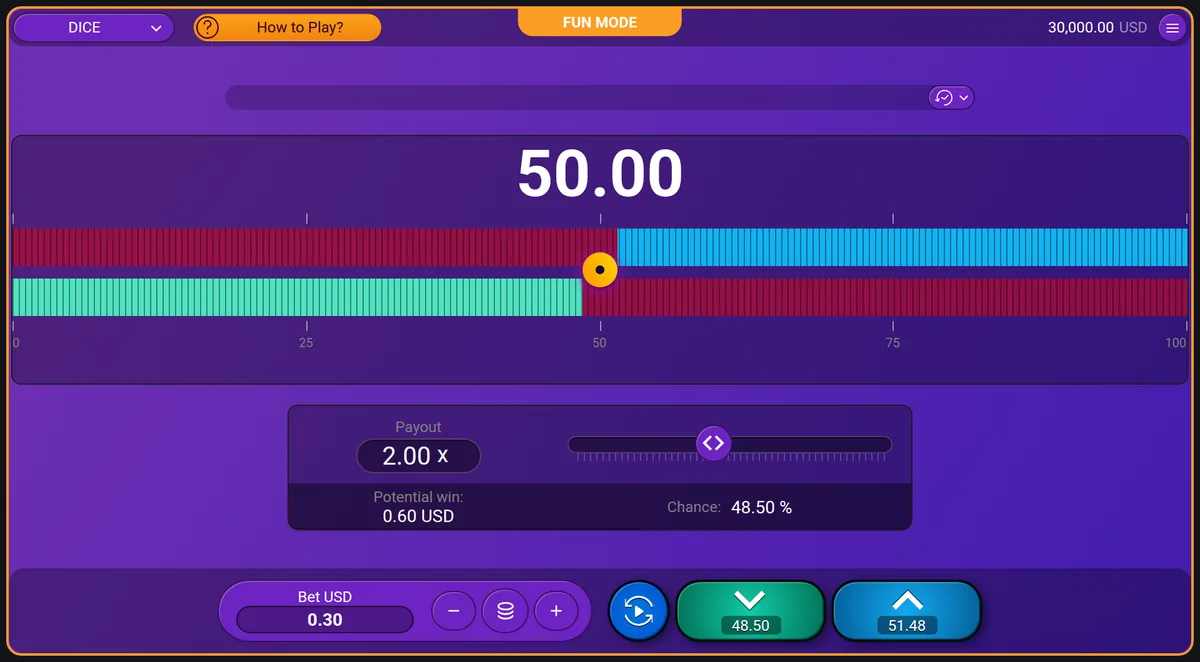
What the game looks like with the numbers on screen
The figures that decide the game are printed in the interface, not buried in a help page. The frame below is our own, taken from the studio's public demo in play money.
What a crypto dice page usually leaves out
Two things, almost always. The first is that the margin is a property of the rules rather than of the operator, so a page comparing casinos on it is comparing them on something none of them sets. The second is that a published return figure belongs to the game's own information panel, and reprinting one from elsewhere is a guess presented as a fact. How the edge is derived.
Choosing a crypto dice by what it publishes
What genuinely differs between operators is the cashier, the terms and the bonus weighting — all of them documents you can open. Which USDT networks are credited, what the wagering base is, whether this game counts toward turnover at full rate or a fraction. The four clauses, and the six networks.