Searches for crypto crash game mostly land on pages selling a system. This one does not: what follows is the arithmetic of the game, and the line between what the game decides and what an operator decides.
The crash point is decided before the round starts
The value at which the curve stops is generated from a seed pair at the moment the round is created, and its hash is usually published beforehand. The rising curve on screen is an animation of a number that already exists.
That is the useful consequence of the provably fair design: the operator cannot watch where the money is and end the round accordingly, and you can verify that after the fact. It also means no behaviour during the round — yours or anyone else's — influences the outcome.

What a cash-out target actually buys
A low target like 1.2× wins very often and returns very little; a high one wins rarely and returns a lot. Multiply the win probability by the multiplier under either strategy and you land on approximately the same expected value, minus the same edge.
So choosing a target is choosing volatility, not value. The one real advantage of setting it in advance is behavioural: an automatic cash-out removes the decision that a rising number is designed to make difficult.
The round history panel is not information
Every crash game displays recent multipliers, and the display is the single most effective psychological feature in the product. A run of low crashes does not make a high one due. Each round is independent of every round before it.
The history is verifiable, which is genuinely valuable for confirming fairness after the fact. It is not predictive, and treating it as a signal is the most common way money leaves a crash balance.
Doubling after a loss, and why it ends
The martingale — double the stake after each loss so one win recovers everything — fails for two reasons that always apply: your balance is finite, and the table has a maximum stake. A run of eight losses at a 2× target is entirely ordinary, and eight doublings is 256 times the opening bet.
The strategy converts a small, frequent loss into a rare, catastrophic one. The expected value does not improve at any point during that conversion. The arithmetic is indifferent to staking patterns.
Where crash games is worth playing
Ordered editorially, with the one checkable column beside each row: which USDT networks the operator publishes. Why there is no score.
Every button opens the same casino, which is why none of them carries an operator's name.
Where the buttons on this site lead
The casino this site sends readers to
Deposits and withdrawals in USDT, a licence you can look up in the regulator's own register, and a 150% first-deposit bonus from 20 USDT.
- 150% first depositfrom 20 USDT
- USDT in and outno card rail in the middle
- Licence in a public registersearchable by domain
18+ · play within a limit you set before you start
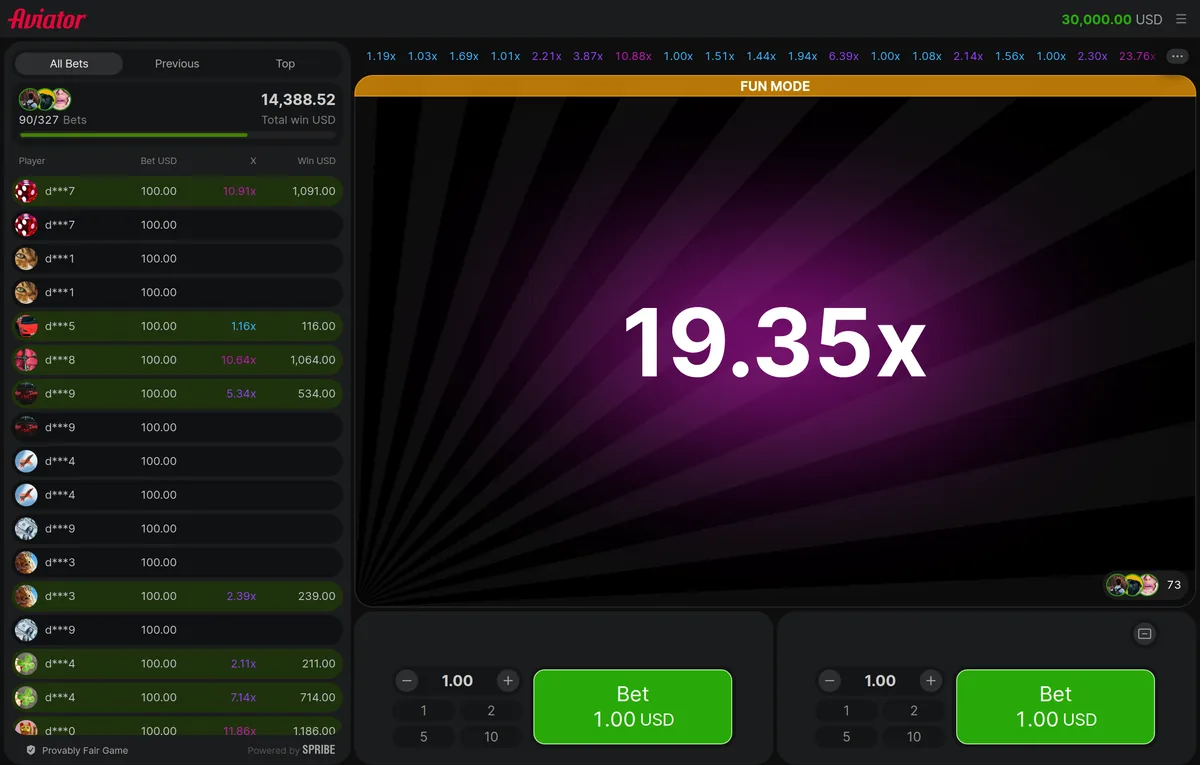
What the game looks like with the numbers on screen
The figures that decide the game are printed in the interface, not buried in a help page. The frame below is our own, taken from the studio's public demo in play money.
What a crypto crash game page usually leaves out
Two things, almost always. The first is that the margin is a property of the rules rather than of the operator, so a page comparing casinos on it is comparing them on something none of them sets. The second is that a published return figure belongs to the game's own information panel, and reprinting one from elsewhere is a guess presented as a fact. How the edge is derived.
Choosing a crypto crash game by what it publishes
What genuinely differs between operators is the cashier, the terms and the bonus weighting — all of them documents you can open. Which USDT networks are credited, what the wagering base is, whether this game counts toward turnover at full rate or a fraction. The four clauses, and the six networks.