Searches for plinko casino mostly land on pages selling a system. This one does not: what follows is the arithmetic of the game, and the line between what the game decides and what an operator decides.
What the board is actually doing
Each pin sends the ball left or right. A board with sixteen rows therefore produces sixteen coin-flips in a row, and where the ball lands is decided by how many went left. Landing in the middle can happen thousands of ways; landing in the outermost slot can happen exactly one way.
That is the whole design. The middle slots pay less than your stake because they are overwhelmingly likely; the edge slots pay a large multiple because they are rare. Multiply each slot's probability by its multiplier, add them up, and the shortfall from your stake is the house edge.
What the risk setting changes
Nothing about the odds of reaching a slot — the pin layout is fixed. It changes the multiplier table: high risk lowers the centre and raises the edges, low risk does the opposite. The distribution of outcomes moves; the expected value stays roughly where the operator set it.
So risk level is a volatility control, not a value control. High risk means longer stretches of small losses punctuated by rare large wins; low risk means a slow, steady drift. Neither is the better setting, and both cost the same over enough drops.
Why no pattern exists to find
Each drop is independent. A run of centre landings does not make an edge landing due, and no amount of history changes the next ball's path. This is the gambler's fallacy in its purest form, and plinko's fast pace makes it unusually tempting.
Plinko is normally one of the operator's own originals, which means it usually runs on a provably fair mechanism. That lets you confirm a result was not altered. It does not lower the edge, and it does not create a pattern.
Auto-play and the arithmetic of speed
Every plinko implementation offers automated drops, often hundreds per minute. Speed does not change the edge per drop; it changes how many drops the edge is applied to per hour, which is the same thing as multiplying your exposure.
If a session is a budget, the useful control is the number of drops, not the stake. Session limits exist on most operators and are the cheapest thing to set before starting.
Where plinko is worth playing
Ordered editorially, with the one checkable column beside each row: which USDT networks the operator publishes. Why there is no score.
Every button opens the same casino, which is why none of them carries an operator's name.
Where the buttons on this site lead
The casino this site sends readers to
Deposits and withdrawals in USDT, a licence you can look up in the regulator's own register, and a 150% first-deposit bonus from 20 USDT.
- 150% first depositfrom 20 USDT
- USDT in and outno card rail in the middle
- Licence in a public registersearchable by domain
18+ · play within a limit you set before you start
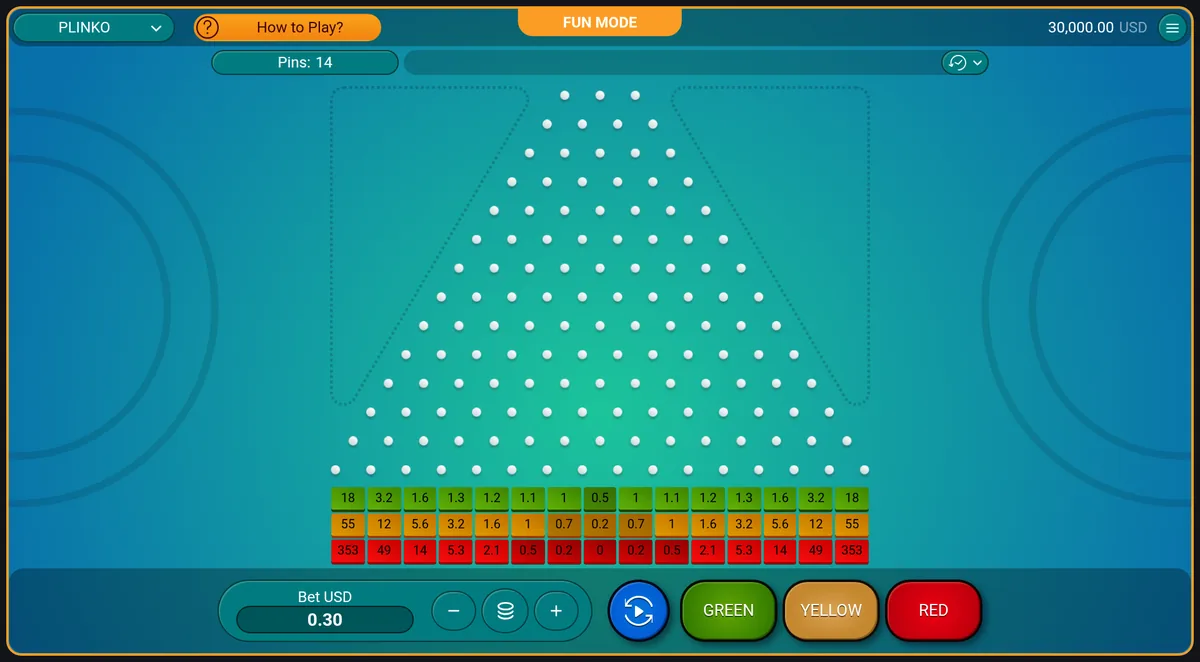
What the game looks like with the numbers on screen
The figures that decide the game are printed in the interface, not buried in a help page. The frame below is our own, taken from the studio's public demo in play money.
What a plinko casino page usually leaves out
Two things, almost always. The first is that the margin is a property of the rules rather than of the operator, so a page comparing casinos on it is comparing them on something none of them sets. The second is that a published return figure belongs to the game's own information panel, and reprinting one from elsewhere is a guess presented as a fact. How the edge is derived.
Choosing a plinko casino by what it publishes
What genuinely differs between operators is the cashier, the terms and the bonus weighting — all of them documents you can open. Which USDT networks are credited, what the wagering base is, whether this game counts toward turnover at full rate or a fraction. The four clauses, and the six networks.